Think about the last time you saw something you wanted to buy, identify, or fix.
Did you pull out your laptop, open Google, and carefully construct a 6-word phrase to describe it? Or did you pull out your phone, point your camera, circle the object on your screen, and let Google figure it out for you?
Visual search is no longer a futuristic gimmick—it is a core habit for hundreds of millions of web users. To reflect this shift, Google Search Console recently introduced a powerful new performance dimension: Multimodal Search.
If you own a business, manage marketing, or care about website traffic, this update changes how you evaluate SEO. Here is an in-depth breakdown of what multimodal search actually is, why it holds immense business value, which industries benefit most, and how you can optimize your digital presence to win visual market share.
What is “Multimodal” feature in Google Search Console
Nestled right under the Search Type filter section of Google Search Console’s Performance tab (in addition to Web, Image, Video and News) is the Multimodal report, which isolates traffic triggered when a user begins a search query with an image or visual asset instead of typewritten text.
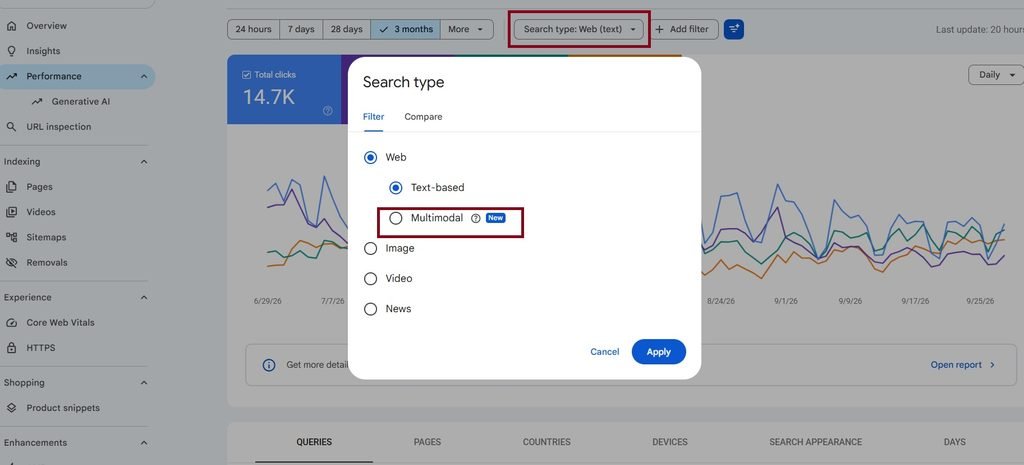
Google Search Console -> Performance —> Search Type
- Web (Traditional typed queries)
- Image (results on tab in Google Images)
- Multi-modal → Lens, Circle to Search, Photo Uploads
- Video
- News
Since earlier times, web analytics engines failed to distinguish the traditional image browsing and camera-assisted shopping. The classic “Image” tab in GSC only measures impressions and clicks from the native Google Images tab.
Multimodal search is fundamentally different. Specifically, it will track deep visual-to-web user journeys from toolsets such as:
- Google Lens: Users taking pictures or choosing photos from their cell phone roll to identify products, objects, or even text.
- Circle to Search: A very useful (but not widely known feature) for Android users where you draw a continuous gesture with your finger around any image or video element on their screen so that it immediately starts searching without having to switch apps.
- Image Upload & Drops: Users dragging pictures directly into the primary Google search bar, either from a desktop or a mobile device.
- Multimodal AI overviews: the concept is to submit an image with a prompt as a search (for example, uploading a photo of a plant along with the text “brain work for me? Why do leaves look yellow?”).
The Catch: Why Is Your “Queries” Tab Empty?
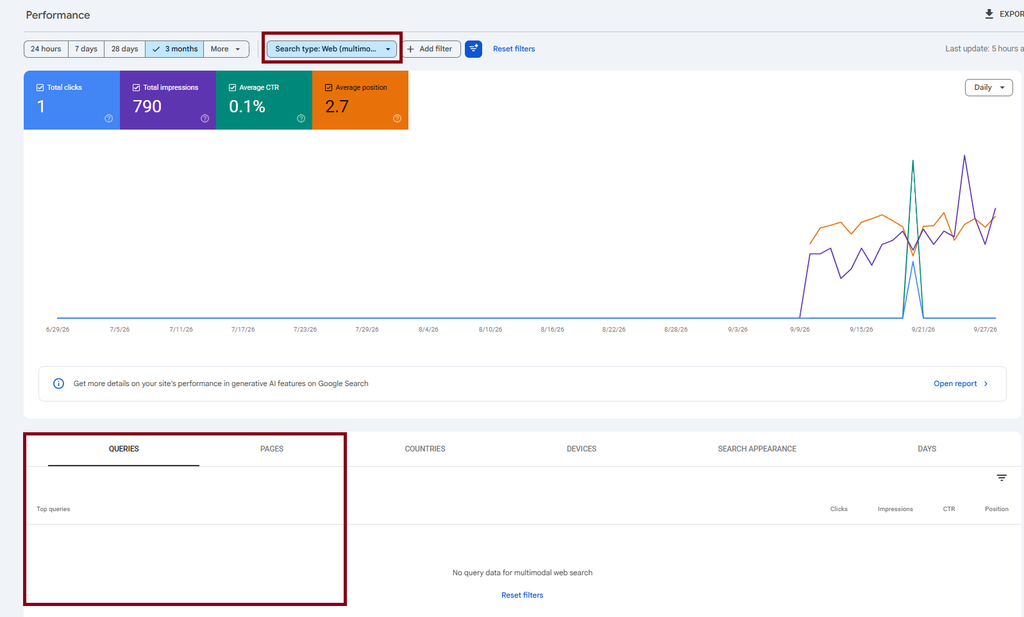
When you turn the GSC filter to Web: Multimodal, you may be shocked at what you see in the search terms list.
This is entirely by design. Being from visual pixel data, multimodal queries do not always come with an attached typed keyword as the first element of the search.
Guidelines for Analysing Your Multimodal Performance
- Go to Performance > Search type: Multimodal.
- Go to the Pages tab instead of Queries.
- Let you know which landing pages and product URLs will be getting visual impressions and clicks.
- Analyse the imagery, mark-up and context on those winning pages to identify what Google’s image classifier prefers.
A Direct Comparison: Multimodal vs Image vs Text Search
Multimodal search channels are but one tool in any actionable search strategy, as you can see how they stack up against traditional channels:
| Feature | Standard Text Search | Traditional Image Search | Multimodal Search |
| User Input | Typed words or voice commands | Typed words in Google Images | Photo, camera scan, or screenshot |
| Entry Point | Google.com search bar | Google Images tab | Google Lens, Circle to Search, AI prompts |
| Query Data in GSC | Complete keyword lists | Keyword search terms | Page-focused data (no keyword text) |
| Primary Ranking Factors | Written context, titles, backlink profiles | Image file names, alt text, page titles | Image clarity, object isolation, Schema markup, page context |
| Buyer Intent | Informational, navigational, transactional | Inspiration, stock photos, visual ideas | Buy-Direct purchase matching of high commercial intent |
Why Multimodal Search Is a Massive Growth Opportunity
Multimodal search represents one of the highest-converting traffic channels available today. Here is why prioritizing it will drive direct return on investment:
1. Ultra-High Purchase Intent
When someone circles a jacket in an Instagram post or takes a picture of a coffee table at a friend’s house, they aren’t looking for a history lesson on furniture design. They want to know who sells it, how much it costs, and how fast it can be delivered. Capturing visual searchers places your business right at the bottom of the buying funnel.
2. The Bridge to AI-First Discovery
Generative search engines and AI assistants process multi-sensory inputs. When users ask AI engines to solve complex physical problems—like identifying an auto part or diagnosing a lawn disease—the AI relies on multimodal indexes. Optimizing your site for visual search positions your brand to be recommended inside AI-generated answers.
3. Early-Mover Advantage
Most of your competitors are still exclusively tracking traditional text keywords. By auditing your visual assets now and structuring your website for multimodal discovery, you can claim high-ranking visual placements before the rest of your industry catches on.
How Multimodal Search Represents a Huge Growth Opportunity
Multimodal search is one of the fastest converting traffic channels. So, if you are going to prioritize it here is why will deliver direct return on investment:
- Ultra-High Purchase Intent: When someone circles a coat in an Instagram post or snaps a photo of their friend’s coffee table, the last thing they’re seeking is a furniture design history lesson. Curious about what it is sold for, and how quickly it could be shipped. In fact, visual searchers bring your business directly to the bottom of the funnel.
- The Bridge to AI-First Discovery: Multi-sensory Inputs: In other words, generative search engines and AI assistants. When users ask AI engines a complicated physical question, such as identifying an auto part or diagnosing a lawn disease, the AI uses multimodal indexes. Optimizing your visually search friendly site allows your brand to be recommended inside an AI-generated answer.
- Early-Mover Advantage: All of your competitors are still historically tracking just simple text keywords. Audit your visual assets today, organize your website for multimodal discovery, and win high-visibility visual placements before the rest of your industry wakes up to the opportunity.
What Industries Does Multimodal SEO Work Best For?
All sites should be monitoring visual metrics, but there are four industries that could start making money immediately with multimodal optimization:
Top Multimodal Impact Sectors:
- E-Commerce & Retail (Fashion, Jewellery, Home Goods, Consumer Tech)
- Home Services & Trade Pros (Plumbing, HVAC, Electrical)
- Hospitality &Tourism ( Hotels, Restaurants, Event Venues )
- Industrial & Automotive (Machine Components, Component Repairs)
E-Commerce & Retail: Consumers continue to screenshot items of interest on social media or take pictures in stores looking for a cheaper price point online.
Home Services & Repairs: Because homeowners seldom remember the technical term for a broken pipe connection or some obscure kind of electrical breaker They search by taking a photo.
Hospitality & Local Dining: Travelers take photos of dishes, interiors or surroundings and are provided with a list of matching venues, menus and toggles for reservations.
Industrial Parts Suppliers: B2B buyers frequently rely on visual search to find replacement parts when serial numbers fade away over time.
Case Studies: The Impact of Visual Search on Conversion
Scenario 1: Retail & E-Commerce
A shopper admires an elegant brass desk lamp in a boutique hotel lobby. Highlight lamp on phone using Circle to Search. However, Google Lens compares the visual attributes—the curvature of the base, the finish, and shade type matches it straight to your e-commerce store’s product page. Your page has strong product images and clear pricing, so the shopper navigates through and makes a purchase.
Scenario 2: Emergency Local Services
Case #1: On a commercial property, the property manager notices a leaking valve on an industrial boiler system. Since they don′t know what manufacturer it is, but snap a Google Lens picture. The visual geometry of the valve is matched by Google to a diagnostic repair guide on your plumbing service blog. A manager arrives at your page, sees that you have the skill, and hits Request Emergency Service.
Practical Steps: How to Prepare Your Website for Multimodal Search
In order to attract visual search traffic, you need to go beyond tagging the image. Follow this step-by-step optimization framework:
- Publish Images of Your Real Product, Projects and Team, Computer vision algorithms easily distinguish generic stock assets from unique real-world items.
- Use Structured Data (JSON-LD Schema): Provide clear contextual data directly to search engines with Schema markup:
- For retails use Product schema (image, offers, price and availability)
- If applicable include schema for Image Object such as defining subject matter of images, licensing image licenses and captions.
- For service companies, use Local Business schema combined with geo-tagged project photos
- Give Descriptive Names to Your Files Prior to Uploading (e.g., brushed-brass-pendant-light. jpg instead of IMG_0042. jpg). Natural text surrounds with images and Write more Alt-Text based on visual details about the object.
- Ensure a High Performance on Mobile: Over 90% of visual searches are done with mobile devices. Deliver next-gen formats (WebP or AVIF) images and ensure a page speed that loads fast while retaining the image’s resolution.
Take your organic growth to the next level with our expert search engine optimization services
SEO has come a long way from just tracking keywords. But in the current search landscape, success hinges on an integrated approach that combines text+, voice/text, sight/action, and AI discovery.
Every day people look for solutions with the use of their cameras – if your website is not optimized for multimodal search, you are missing out on high-intent leads!
We offer technical, visual and AI-driven search strategies to convert search visibility into revenue. We offer a full range of SEO Optimization Services which consists of:
- Occult Visual Traffic: Multimodal Performance Audits
- Technical Schema Architecture: Structured Data Deployment (To ensure Google and AI Search Engines can read your visual assets)
- Graphic Content Optimization: Formatting product & service landing pages to rank on Lens Circle To Search and AI Overviews.
- Analytics-Driven by Revenue: Establish custom reporting dashboards to monitor visibility, clicks as well as client conversions.
The latest search features from Google grab high-intent leads, are you ready to harvest new leads?
Book a full strategy session with our SEO team now and see how we can help you improve organic search.
Frequently Asked Questions (FAQs)
What does it mean that nothing will appear for me under the Web: Multimodal filter?
If a report in Multimodal shows up empty, that means your site still hasn’t hit Google’s minimum data threshold for camera-led searches. When you start publishing original photography, use structured Schema markup and optimize mobile landing pages, visual traffic will register in your reporting.
Is Google Image search also Multimodal search?
No. Google Image search monitors searches where the user enters text in the Google Images tab to get pictures. Multimodal search: a fashion and journey recognition tracking aspects when these journeys start with an image or camera scan (through Google Lens and intermediaries like Circle to Search, or uploading photos) that are actually jumping directly into pages and shopping results.
How about tracking the exact keywords that users typed during a visual search?
In most cases, no. As multimodal queries start with visual pixel data, therefore the text keywords are rarely displayed for this filter by google Instead, measure performance using the Pages tab within Search Console to see which landing pages are drawing in visual search noise.
Top reasons to hire a digital agency for multimodal SEO
Thus, multimodal SEO combines sophisticated technical markups, mobile loading speed optimization, image structuring friendly with computer vision, and content strategy. Your whole website architecture is designed so that the visual searchers find you & turn into paying clients with an expert agency.